
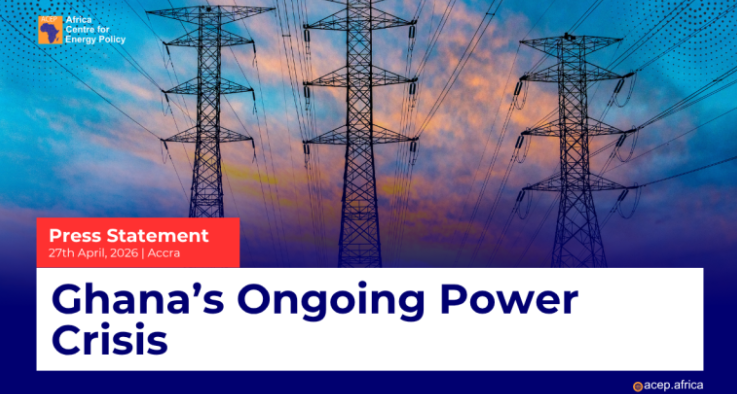
- Ghana's worsening power crisis has been flagged by the Africa Centre for Energy Policy (ACEP) as a major threat to economic activity and public confidence in the energy sector.
- The think tank has expressed concerns over the quality of communication from power sector operators, irregularity of updates on outages, and the scale and duration of blackouts.
- ACEP has called for a thorough investigation into the Akosombo substation fire, urging authorities to focus on addressing structural weaknesses in the sector.
- The organisation also demands full public disclosure of all investigation findings to ensure accountability and restore public trust.
Ghana, like many other countries, has long struggled with power outages, but the current situation is becoming increasingly dire. Over a month of escalating power cuts has left households, businesses, and institutions reeling, with widespread load shedding reported across the country.
The situation has been compounded by a recent fire incident at the Ghana Grid Company's Akosombo substation, which has taken out approximately 960 megawatts of relatively cheaper and reliable generation capacity.
Background: Ghana's Power Sector Challenges
Ghana's power sector has faced numerous challenges in recent years, including constraints in natural gas supply and processing, inadequate maintenance, and inefficiencies in planning. These issues have resulted in frequent power outages, affecting economic activity and public confidence in the energy sector.
The country has invested heavily in developing its power sector, but the pace of progress has been slow. The lack of a reliable power supply has hindered economic growth, making it difficult for businesses to operate efficiently.
ACEP's Concerns Over Power Sector Communication
The Africa Centre for Energy Policy (ACEP) has expressed grave concern over the quality of communication from power sector operators. The think tank notes that updates on outages have been irregular, inconsistent, and unreliable, with blackouts often extending beyond announced areas.
ACEP's Policy Lead for Petroleum and Conventional Energy, Kodzo Yaotse, stated that the organisation has repeatedly raised concerns over the lack of transparency in power sector communication. Yaotse noted that similar claims in the past by the Electricity Company of Ghana were later found to be inaccurate following independent audits by the Public Utilities Regulatory Commission.
Systemic Challenges and the Need for Urgent Action
ACEP argues that the scale and duration of the outages point to deeper systemic challenges in the power sector. The organisation urges the Minister for Energy and Green Transition to avoid short-term emergency measures that could create long-term financial and operational risks.
Instead, ACEP calls for a focus on addressing structural weaknesses in the sector, including constraints in natural gas supply and processing, inadequate maintenance, and inefficiencies in planning. The organisation also demands a thorough and credible investigation into the Akosombo substation fire.
Looking Ahead: Restoring Public Trust and Ensuring Accountability
As part of immediate measures, ACEP calls on authorities to publish a reliable load-shedding timetable to enable households and businesses to plan effectively. The organisation also urges system operators to provide a clear timeline for restoring full power supply.
Furthermore, ACEP demands full public disclosure of all investigation findings, including any evidence of misconduct or systemic failure, to ensure accountability and restore public trust in the energy sector.

0 Comments
Leave a Comment
No comments yet. Be the first to share your thoughts!