
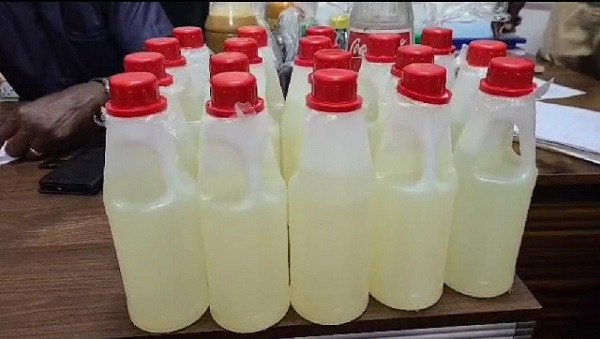
The Department of Pharmacology at the Kwame Nkrumah University of Science and Technology (KNUST) has released a chilling report following the laboratory analysis of a substance known as "Madala," which has been circulating in Kumasi markets. The substance, marketed by traders as a potent "heart cleanser" and general health tonic, was revealed to be a highly corrosive and lethal chemical cocktail. In a series of controlled tests conducted by the university's researchers, it was observed that the liquid instantly melted through a plastic takeaway bowl, raising immediate alarms regarding its impact on human internal organs if ingested.
The scientific investigation was triggered by a coordinated raid led by the Ashanti Regional National Security in the "French Line" section of the Kumasi Central Market. Operatives, acting on intelligence that Nigerien dealers were supplying the unapproved substance to local retailers, seized several containers of the dark liquid. To confirm the toxicity beyond its corrosive nature, the KNUST Pharmacology team administered samples to laboratory mice. The results were devastating: all test subjects died within 48 hours of exposure, confirming that "Madala" poses a severe and potentially fatal risk to the public.
National Security officials, including the Ashanti Regional Deputy Coordinator, Alhaji Nje Abdallah Umaru, expressed deep concern over the brazenness of the traders. Four suspects—comprising one male and three females—were arrested during the Thursday, February 27 operation and are currently in custody. The suspects reportedly targeted unsuspecting residents looking for affordable "traditional" remedies for cardiovascular issues. National Security also noted a significant delay in receiving test results from the Food and Drugs Authority (FDA), praising KNUST for stepping in to provide the rapid scientific evidence needed to remove the product from the shelves.
The "Madala" scare highlights a growing trend of unregulated and dangerous chemical mixtures being rebranded as traditional medicine in Ghanaian metropolitan areas. The Pharmacology Department at KNUST has warned that the ingredients in the substance appear to be industrial-grade chemicals not fit for any form of human consumption. Ingesting such a liquid would likely cause permanent damage to the esophagus, stomach lining, and kidneys, often leading to a painful death or lifelong disability.
In the wake of these findings, security forces have intensified their surveillance of the Kumasi Central Market and Aboabo Station to track down other suppliers. Public education campaigns are being rolled out across local radio stations to warn citizens against purchasing unlabelled liquids from unauthorized vendors, regardless of the health claims made. As the four suspects await formal charges, the collaboration between National Security and the KNUST academic community serves as a critical shield against the "poison trade" threatening the lives of the most vulnerable in society.
Cover Image Source: ghanaweb.com



0 Comments
Leave a Comment
No comments yet. Be the first to share your thoughts!