
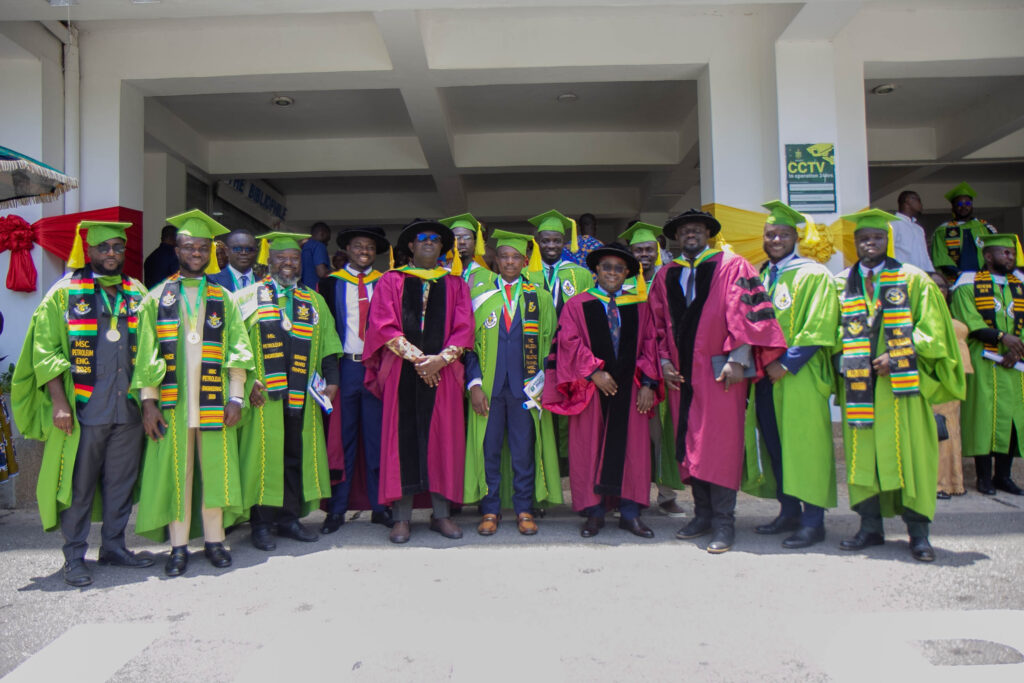
- Kwame Nkrumah University of Science and Technology (KNUST) has produced its largest cohort of 25 Master's graduates in Petroleum Engineering.
- This year's graduating class represents a 100% increase from the inaugural cohort, underscoring growing interest and demand for specialized energy skills.
- The programme, designed to meet both local and international industry demands, achieved a commendable 90% completion rate.
- Graduates are equipped with advanced skills in areas such as well engineering, reservoir management, natural gas engineering, and health, safety, and environment (HSE).
The Kwame Nkrumah University of Science and Technology (KNUST) in Kumasi has marked a significant milestone, graduating its largest cohort of Master's degree students in Petroleum Engineering. A total of 25 highly trained professionals completed the rigorous programme, a substantial increase that reflects the growing demand for specialized technical expertise within Ghana's burgeoning energy sector and the wider international market.
This achievement represents a remarkable 100% increase in graduates compared to the programme's inaugural cohort last year, which saw 12 students successfully complete their studies. The expansion highlights a strategic response by KNUST to the evolving needs of the energy industry, which requires a robust pipeline of skilled professionals to navigate its complexities and drive sustainable development.
Furthermore, the Petroleum Engineering Master's programme demonstrated an impressive 90% completion rate. Most students successfully finished their studies within the expected timeframe, signaling the efficacy of the curriculum and the dedication of both faculty and students. This high success rate positions KNUST as a pivotal institution in Ghana's efforts to localize expertise in critical industrial domains.
Ghana's Evolving Energy Landscape and the Demand for Local Expertise
Ghana's journey as an oil-producing nation began with the discovery of the Jubilee Field in 2007, leading to first oil production in December 2010. This pivotal moment ushered in a new era for the country, bringing both immense economic opportunities and the crucial need for robust local human capital development. Subsequent discoveries, such as the TEN (Tweneboa, Enyenra, Ntomme) and Sankofa Gye Nyame fields, further solidified Ghana's position on the global energy map.
The continuous growth of Ghana's upstream oil and gas sector necessitates a steady supply of highly skilled engineers and technical experts. These professionals are essential for managing complex exploration, production, and refining processes, ensuring operational efficiency, and adhering to stringent environmental and safety standards. Developing local capacity reduces reliance on expatriate labour and ensures that a greater share of the industry's economic benefits remain within the country.
Beyond the traditional oil and gas industry, Ghana is also navigating the global energy transition, which introduces new challenges and opportunities. While hydrocarbons remain vital for economic stability and energy security, there is an increasing focus on optimizing resource extraction, minimizing environmental impact, and exploring renewable energy alternatives. Petroleum engineers with a holistic understanding of energy systems are thus critically important.
KNUST's Strategic Curriculum and Global Competitiveness
The Petroleum Engineering Master's programme at KNUST is meticulously designed to equip graduates with a comprehensive suite of skills essential for both current and future energy demands. Students receive in-depth training across core areas, including well engineering, production engineering, reservoir appraisal and development, natural gas engineering, and vital health, safety, and environment (HSE) protocols.
Well engineering focuses on the design, construction, and maintenance of oil and gas wells, a fundamental aspect of hydrocarbon extraction. Production engineering deals with optimizing the flow of hydrocarbons from the reservoir to the surface and processing facilities. Reservoir appraisal and development involves understanding subsurface geology and maximizing recovery rates from oil and gas fields, ensuring long-term sustainability.
Furthermore, training in natural gas engineering addresses the increasing importance of gas as a cleaner transition fuel, while the emphasis on HSE ensures that graduates are well-versed in industry best practices for operational safety and environmental protection. These diverse competencies prepare graduates for a wide array of roles across the entire oil and gas value chain, from exploration to downstream operations.
Ing. Dr. Kwame Sarkodie, the Head of Department, articulated the programme's expansive vision. He emphasized that the training is not merely tailored for the Ghanaian context but is also strategically designed to serve sub-Saharan Africa and the wider international community. This global outlook aims to produce graduates who are not only locally relevant but also internationally competitive, capable of excelling in diverse energy markets worldwide.
Dr. Sarkodie also extended commendation to the dedicated faculty members whose expertise and commitment underpin the programme's success. Notable contributions came from **Dr. Yen Adams Sokama-Neuyam**, **Dr. Samuel Erzuah**, **Dr. Caspar Daniel Adenutsi**, **Dr. Stephen Adjei**, and **Dr. Jonathan Atuquaye Quaye**. Their collective academic and practical experience ensures the delivery of high-quality, industry-relevant education.
KNUST's Broader Commitment to Engineering Excellence
This achievement in Petroleum Engineering is part of a broader trend at KNUST, which has been consistently expanding its graduate engineering programmes in recent years. The university, renowned as one of Africa's leading science and technology institutions, recognizes its pivotal role in national development and industrial growth.
Petroleum engineering has emerged as a particularly key area of growth, driven by converging interests in energy security, efficient resource management, and sustainable industrial development. KNUST's proactive approach ensures that Ghana's human capital is aligned with strategic national priorities and global energy trends, fostering innovation and economic resilience.
The university's commitment extends beyond individual programmes, aiming to cultivate a culture of research and development that addresses real-world challenges. By producing graduates with advanced technical and analytical skills, KNUST contributes significantly to Ghana's capacity for self-reliance in vital economic sectors.
Future Prospects for Graduates and the Energy Sector
The newly graduated master's professionals are poised to enter critical roles across the entire oil and gas value chain. There remains a persistent demand for specialized skills in areas such as geological exploration, efficient production techniques, and stringent environmental safety management. These graduates will play a crucial role in enhancing operational efficiencies and ensuring responsible resource stewardship.
Moreover, as Ghana continues to develop its local content capabilities within the energy sector, these highly trained individuals will be instrumental in driving indigenous companies and expertise. Their contribution is vital for establishing a robust local supply chain and fostering a transfer of technology and knowledge within the country.
The expansion of graduate engineering programmes at institutions like KNUST signifies a strategic investment in Ghana's future. It underscores the nation's ambition to move beyond merely extracting raw materials to developing the intellectual and technical capacity to manage, innovate, and add value across its critical industries. This record graduation not only celebrates academic success but also fortifies Ghana's position in the competitive regional and global energy landscape.
In conclusion, the record number of Petroleum Engineering Master's graduates from KNUST is a testament to the university's dedication to academic excellence and its responsiveness to national industrial needs. By equipping a new generation of Ghanaian engineers with advanced skills, KNUST is directly contributing to the nation's energy security, economic diversification, and its aspirations to become a leading hub for specialized expertise in Africa.






0 Comments
Leave a Comment
No comments yet. Be the first to share your thoughts!