
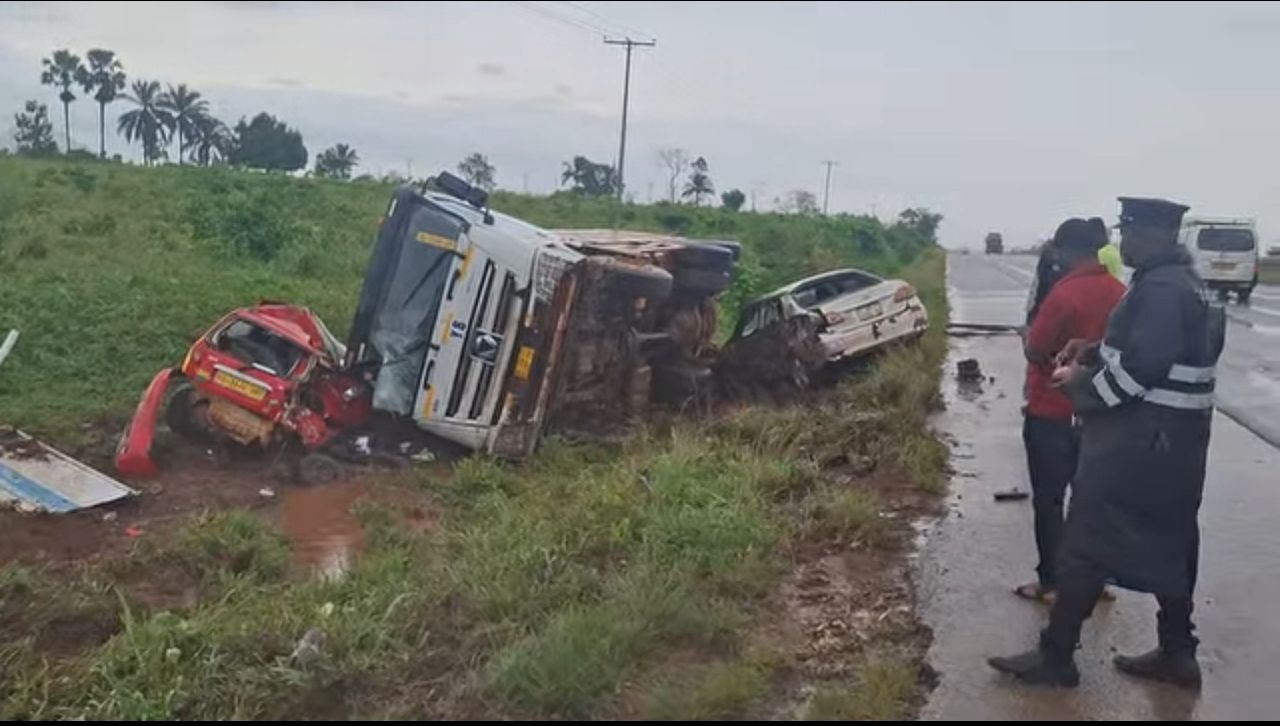
- A three-vehicle collision occurred on Palm Sunday morning at Tadieso, near the University of Education, Winneba (UEW) Techiman Distance Learning Central junction.
- Several individuals sustained various degrees of injuries and were promptly transported to the Techiman Holy Family Hospital for medical attention.
- The incident, which involved a taxi, a private saloon car, and a tipper truck, took place during a downpour on the Techiman-Kumasi road.
- Authorities have commenced investigations to ascertain the precise cause of the accident and are managing traffic at the scene.
A significant road incident unfolded on Palm Sunday morning, leaving several individuals injured following a three-vehicle collision at Tadieso, a community situated close to the University of Education, Winneba (UEW) Techiman Distance Learning Central junction. The accident occurred on the busy Techiman-Kumasi road, a vital economic artery connecting Ghana's Bono East Region to the Ashanti Region, around 10:00 a.m. amidst a heavy downpour. While no fatalities were reported, the collision has drawn attention to persistent road safety challenges, particularly during adverse weather conditions.
The vehicles involved in the incident included a Kia Picanto taxi cab with registration number GS 3644-19, a Toyota Corolla saloon private car registered as GT 4164-20, and a tipper truck bearing the registration number GS 1139-25. All three vehicles were reportedly travelling in the Kumasi direction when the crash occurred. Eyewitnesses indicated that the taxi was returning from the UEW learning centre after dropping off students, while the tipper truck and the Toyota saloon were both en route to Kumasi from Techiman.
Immediate Response and Medical Attention
Following the impact, local residents and passersby quickly mobilised to assist the victims. Emergency services were alerted, and the injured were promptly rushed to the Techiman Holy Family Hospital. While the exact number of casualties and the specific nature of their injuries have not been publicly detailed, initial reports confirm that victims sustained varying degrees of injuries, none of which were immediately life-threatening. The swift evacuation and medical attention are critical in such situations, often significantly improving recovery outcomes.
Hospitals along Ghana's major road networks play a crucial role in post-accident care. The promptness with which victims receive medical attention, including first aid and transport, is paramount. This incident underscores the importance of well-equipped emergency response units and accessible healthcare facilities along major highways, which are often prone to traffic accidents due to high speeds and heavy vehicular movement.
Police Investigation and Traffic Management
Upon receiving reports of the accident, police officers from the Motor Traffic and Transport Department (MTTD) quickly arrived at the scene. Their immediate priorities included securing the area, facilitating the evacuation of the injured, and managing the resulting traffic congestion. The Techiman-Kumasi road is a principal transit route, and any obstruction can lead to significant delays and further risks. Officers have since returned to the scene to conduct a thorough investigation and ensure the smooth flow of traffic, preventing secondary incidents.
Investigations are currently ongoing to determine the exact sequence of events that led to the collision. This typically involves examining the crash site for skid marks, debris patterns, vehicle damage, and interviewing eyewitnesses and the drivers involved, if their condition permits. Factors such as driver behaviour, vehicle mechanical integrity, road conditions, and environmental factors like the heavy rain will all be meticulously assessed. The findings of such investigations are crucial for assigning responsibility and recommending preventive measures.
Road Safety in Ghana: A Persistent Challenge
This incident at Tadieso adds to the growing concerns about road safety across Ghana. Road accidents remain a significant public health and economic challenge, claiming thousands of lives annually and causing countless injuries. According to data from the National Road Safety Authority (NRSA), Ghana consistently records high numbers of road traffic fatalities and injuries, despite various interventions aimed at curbing the trend. Factors contributing to this alarming situation are multifaceted, encompassing driver indiscipline, poor vehicle maintenance, inadequate road infrastructure, and environmental conditions.
The Techiman-Kumasi road, like many major inter-regional highways in Ghana, experiences heavy traffic volumes, including a mix of private vehicles, commercial passenger vehicles, and heavy-duty trucks. The sheer diversity and volume of traffic, combined with varying levels of driver experience and adherence to traffic regulations, create a complex safety environment. Efforts by the NRSA and the MTTD often focus on public education campaigns, stricter enforcement of traffic laws, and improvements in road engineering, yet the challenge persists.
The Peril of Adverse Weather Conditions
The fact that the accident occurred during a downpour highlights the heightened risks associated with adverse weather conditions. Heavy rain significantly reduces visibility, making it difficult for drivers to perceive hazards and judge distances accurately. Wet road surfaces also drastically reduce tire grip, increasing braking distances and the likelihood of skidding, a phenomenon known as hydroplaning. Drivers are consistently advised to exercise extreme caution, reduce speed, and maintain greater distances between vehicles during rainfall.
Ghana's tropical climate means that heavy rains are a regular occurrence, particularly during certain seasons. This makes it imperative for drivers to be adequately trained and equipped to handle such conditions. Vehicle owners also bear responsibility for ensuring their vehicles, especially tires, brakes, and wipers, are in optimal condition to withstand the rigours of wet-weather driving. Authorities frequently issue advisories urging drivers to slow down, switch on headlights, and avoid sudden manoeuvres during rain to mitigate accident risks.
The Techiman-Kumasi Road: A Critical Economic Artery
The Techiman-Kumasi road is not merely a transport route; it is a vital economic artery that facilitates the movement of goods, services, and people between the northern parts of Ghana and the southern economic hubs. Techiman, a prominent market town, serves as a nexus for trade, making this road exceptionally busy. The constant flow of agricultural produce from the north to the south, and industrial goods in the reverse direction, places immense pressure on the infrastructure and demands high levels of vigilance from road users.
The stretch near the UEW Techiman Distance Learning Central junction, where the accident occurred, is particularly significant due to its proximity to an educational institution. This means an increased presence of students, staff, and visitors, potentially leading to more pedestrian traffic and a need for even greater caution from drivers. Road safety initiatives in such areas often include speed calming measures, clear signage, and designated pedestrian crossings to protect vulnerable road users.
A Call for Collective Responsibility
The Palm Sunday accident serves as a stark reminder of the shared responsibility in ensuring road safety. While police investigations will shed light on the specifics of this incident, the broader narrative points to a need for collective action. Drivers must commit to defensive driving, adhere to speed limits, avoid distractions, and never drive under the influence. Vehicle owners must ensure regular maintenance, especially of critical components like brakes and tires. Passengers also have a role to play in speaking up against reckless driving.
Furthermore, government agencies, including the NRSA, MTTD, and the Ministry of Roads and Highways, must continue to invest in improving road infrastructure, enforcing traffic regulations, and expanding public awareness campaigns. Enhancing driver training, particularly for commercial vehicle operators, and implementing stringent vehicle inspection regimes are crucial steps towards making Ghana's roads safer for everyone. This incident, while tragic for those involved, provides another opportunity to reinforce the imperative of vigilance and caution on our nation's roads.





0 Comments
Leave a Comment
No comments yet. Be the first to share your thoughts!