
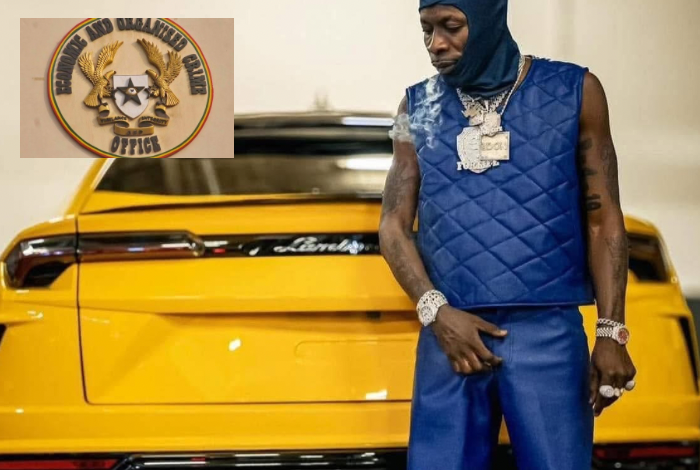
Shatta Wale, born Charles Nii Armah Mensah Jr., is no stranger to controversy, opulence, and dominating the Ghanaian media landscape. However, his latest headline-grabbing saga involves a striking yellow Lamborghini, the Economic and Organised Crime Office (EOCO), and a fiery resurgence of his longstanding feud with the Telecel Ghana Music Awards (TGMA). As videos of the luxurious sports car arriving at the Tema port went viral across social media platforms, what was supposed to be a celebratory moment of celebrity wealth quickly morphed into a high-stakes legal inquiry. The situation has once again thrust the Dancehall King into the center of national debate, intertwining questions of financial scrutiny with his rebellious stance against Ghana’s most prominent music award scheme.
The drama unfolded when footage of a pristine, custom-yellow Lamborghini Aventador being cleared at the port surfaced online, with widespread speculation linking the multi-million-cedi vehicle directly to Shatta Wale. In an industry where flashy cars are the ultimate status symbol, the arrival of such an exotic hypercar naturally sent the 'Shatta Movement' fanbase into a frenzy of celebration. However, the jubilant mood was abruptly interrupted when reports emerged that EOCO had taken a keen interest in the importation of the vehicle. Known for investigating high-level financial irregularities, money laundering, and tax evasion, EOCO’s involvement immediately raised red flags. Sources indicate that the investigative body summoned the musician to clarify the documentation, the source of funding for the extravagant purchase, and to ensure that all appropriate customs duties and luxury vehicle taxes had been fully satisfied before the car hit the streets of Accra.
For many public figures, a summons from a federal investigative agency would prompt a strategic, PR-managed silence. Shatta Wale, true to his brand, took the exact opposite approach. Utilizing his massive digital footprint, the hitmaker took to social media to address the rumors head-on. In a passionate and characteristically unfiltered live broadcast, he vehemently defended his wealth, attributing his financial muscle to years of relentless hard work, lucrative international collaborations, digital streaming royalties, and a diversified portfolio of investments outside of music. He expressed frustration at what he perceives as a systemic targeting of successful young entertainers by state institutions. According to Shatta Wale, instead of being celebrated for elevating the Ghanaian music industry onto the global stage and bringing foreign exchange into the country, artists are subjected to unwarranted suspicion the moment they display the fruits of their labor.
The Lamborghini investigation also sparked a broader conversation regarding the financial realities of the Ghanaian entertainment sector. While critics argue that state agencies have a constitutional mandate to audit sudden displays of immense wealth regardless of an individual's celebrity status, supporters of the musician argue that the industry has grown exponentially, and artists of Shatta Wale's caliber are legitimately earning millions of dollars. The Dancehall King used the broadcast to educate his audience on the evolving economics of the global music business, detailing how independent artists can amass significant fortunes without relying on traditional corporate sponsorships or local show promoters. He challenged the authorities to extend the same level of rigorous financial scrutiny to politicians and public servants, rather than focusing their resources on creatives who are putting Ghana on the map.
Interestingly, as Shatta Wale addressed the EOCO situation, the conversation organically pivoted toward another major talking point: his glaring absence from the ongoing Telecel Ghana Music Awards (TGMA) season. With the recent release of the 2026 nominee list, fans quickly noticed that Shatta Wale’s name was once again missing from all major categories, despite having several hit songs in heavy rotation over the past year. Taking the opportunity to clear the air, he delved into the exact reasons why he has adamantly refused to file for a TGMA nomination for nearly a decade, dating back to his initial grievances around 2017 and culminating in the infamous 2019 ban that reshaped the award scheme's history.
According to Shatta Wale, his boycott is fundamentally rooted in the economics and respect for the artist. He argued that the award scheme, organized by Charterhouse, operates on a business model that heavily exploits the intellectual property and immense popularity of the musicians without offering adequate financial compensation in return. He pointed out that artists invest millions of cedis into studio time, music video production, and promotional campaigns to create the hits that ultimately sustain the award show's relevance and viewership. Yet, when the awards are handed out, the artists receive a plaque while the organizers walk away with massive sponsorship deals and television broadcasting revenues. For Shatta Wale, participating in the TGMAs is no longer a metric of success; rather, it is a system he views as fundamentally flawed and financially disrespectful to the creators who fuel it.
He further elaborated that his focus has entirely shifted towards building independent wealth and securing his legacy, which ties directly back to his ability to purchase luxury items like the yellow Lamborghini. By bypassing local award politics, he claims to have unlocked greater mental peace and financial freedom, allowing him to focus on international markets and direct-to-consumer monetization strategies. He urged the younger generation of emerging Ghanaian artists to prioritize their business acumen, copyright ownership, and streaming revenue over the validation of a local award plaque. His message was clear: true industry dominance is measured by bank balances, property ownership, and global reach, not by the number of trophies sitting on a shelf.
As the EOCO investigation into the Lamborghini reportedly continues through official channels, Shatta Wale remains unbothered, actively promoting his upcoming projects and maintaining his position as one of Africa's most polarizing and successful entertainers. The entire saga perfectly encapsulates the duality of his career. On one hand, he is a target for regulatory scrutiny due to his unapologetic displays of extreme wealth; on the other hand, he remains a fierce advocate for artist empowerment and financial literacy within a developing industry. Whether the Lamborghini ends up cruising down the N1 highway or remains parked amidst legal red tape, Shatta Wale has once again proven his unparalleled ability to dominate the national conversation, turning a potential legal hurdle into a masterclass in public relations and industry critique.


0 Comments
Leave a Comment
No comments yet. Be the first to share your thoughts!