
- Ghana successfully championed a resolution at the United Nations General Assembly, overwhelmingly adopted with 123 votes, recognizing the transatlantic slave trade as the “gravest crime against humanity.”
- President John Mahama, in his capacity as African Union Champion for Reparations, led Ghana's diplomatic efforts, emphasizing the resolution's role in advancing global dialogue on justice and reparative measures.
- The resolution’s adoption underscores a significant collective victory for African nations, people of African descent, and international allies seeking historical acknowledgment and redress for the systemic injustices of the slave trade.
- The initiative is poised to lay groundwork for concrete outcomes, including collaboration on CARICOM's 10-point plan for reparative justice, marking a crucial step towards addressing the enduring legacies of this historical atrocity.
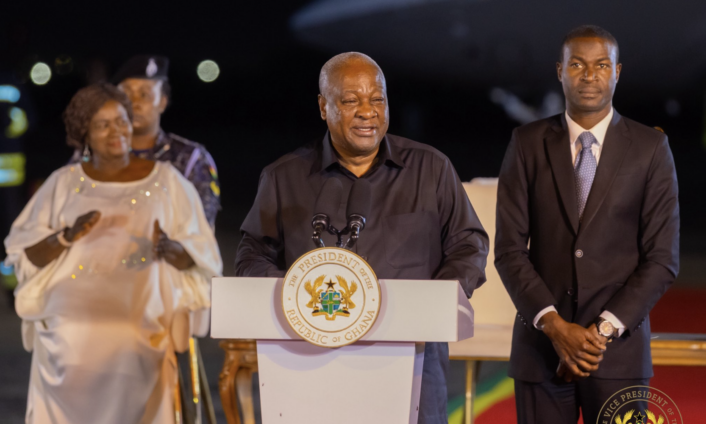
Accra, Ghana – President John Mahama returned to a warm reception at the Kotoka International Airport on Sunday, following a pivotal diplomatic achievement at the United Nations General Assembly (UNGA) in New York. Ghana successfully spearheaded a resolution that has formally recognized the transatlantic slave trade as “the gravest crime against humanity.” This landmark decision, adopted by a significant majority of 123 member states, marks a profound moment in the global pursuit of historical justice and acknowledgment.
The President, greeted by Vice President Professor Jane Naana Opoku-Agyemang and a cross-section of enthusiastic Ghanaians, described the resolution’s adoption as a collective victory. His return signifies not just a personal triumph, but a moment of national pride and an important step forward for the African continent and its diaspora.
UNGA Adopts Ghana's Groundbreaking Resolution
The resolution, tabled by President Mahama in his influential role as the African Union Champion for Reparations, achieved resounding support. Out of 178 votes cast, 123 countries voted in favour, affirming a global consensus on the unprecedented severity of the transatlantic slave trade. This overwhelming endorsement sends a clear message about the international community’s evolving understanding of historical atrocities and their lasting impact.
However, the vote was not unanimous. Three nations – the United States, Israel, and Argentina – cast votes against the resolution, while 52 countries, including several European Union member states and Britain, chose to abstain. These dissenting and abstaining votes highlight the complexities and ongoing debates surrounding historical accountability and reparations on the international stage, despite the strong overall support for Ghana's initiative.
The resolution is meticulously crafted to advance global dialogue on multifaceted issues, including justice, healing, and the implementation of reparative measures. Its adoption provides a crucial framework for future discussions and actions aimed at addressing the profound and enduring legacies of one of history’s most brutal chapters.
A Historical Reckoning: The Transatlantic Slave Trade and its Enduring Legacy
The transatlantic slave trade represents an unparalleled period of human exploitation and suffering, spanning from the 15th to the 19th centuries. During this dark era, an estimated 12 to 15 million Africans were forcibly removed from their homes, subjected to unimaginable brutality, and transported across the Atlantic. Historical records chillingly reveal that up to two million perished during the perilous Middle Passage alone, with countless others dying in violent raids, forced marches, and harsh captivity even before reaching the ships.
Ghana, then known as the Gold Coast, played a tragic and central role as a major transit point for this inhumane trade. Iconic coastal enclaves such as the Elmina Castle and Cape Coast Castle became notorious dungeons and departure points, from which millions of Africans began their involuntary journeys into slavery. These fortresses stand today as poignant reminders of the immense suffering endured and the profound historical scars left behind.
The consequences of the transatlantic slave trade were catastrophic and continue to reverberate across continents. Africa experienced severe demographic, social, and economic distortions, including the loss of its most vibrant populations, the disruption of indigenous societies, and the suppression of economic development. Simultaneously, the forced migration led to the creation of a global African diaspora, whose descendants continue to navigate the systemic disadvantages and historical injustices rooted in this past.
Global Dialogue on Justice and Reparation
Addressing the gathering upon his arrival, President Mahama articulated the broader significance of Ghana’s achievement. “This is a victory not only for Ghana, but for a broad coalition of Africans, people of African descent, CARICOM, and all people of good conscience around the world,” he stated. He underscored the resolution’s importance in consolidating fragmented past efforts to acknowledge the slave trade, asserting that it now places the issue on the “highest global platform” with the definitive declaration that it was “the gravest crime against humanity.”
President Mahama emphasized that the resolution is not merely a historical footnote. “This is not about the past alone. It is about justice, dignity and truth. It is about ensuring that the legacy of slavery is neither forgotten nor trivialised,” he affirmed. This forward-looking perspective highlights the resolution’s intent to serve as a catalyst for contemporary action and a moral imperative for future generations.
The President indicated that this resolution marks the initiation of a crucial process towards achieving concrete outcomes. A key objective includes active collaboration with international partners to advance CARICOM’s comprehensive 10-point plan for reparative justice. This plan outlines a range of demands, from formal apologies and debt cancellation to educational initiatives and cultural restitution, aiming for a holistic approach to address the lasting impacts of slavery.
A Unified Front: Ghana's Diplomatic Triumph
President Mahama used the occasion to commend the dedicated efforts of his diplomatic team, acknowledging their instrumental role in securing this international consensus. He specifically lauded Samuel Okudzeto Ablakwa, the Minister of Foreign Affairs, for his tireless work in mobilising international support. “I gave the guidance, but they did the legwork. The thousands of kilometres he travelled from country to country canvassing support must be acknowledged,” the President stated.
Further praise was extended to Samuel Yao Kumah, Ghana’s Ambassador to the United Nations, and Victor Smith, Ghana’s Ambassador to the United States, along with their respective teams. President Mahama recognized their meticulous preparation and strategic engagement, acknowledging, “They deserve the real honour because they did the work. I only provided the guidance.” This collaborative spirit underpinned Ghana's successful diplomatic campaign.
President Mahama also expressed profound appreciation to CARICOM partners and the 123 nations that supported the resolution. He noted that many of these countries were neither directly affected by nor involved in the transatlantic slave trade, underscoring their decision to vote in favour as an act of profound global conscience and solidarity with victims and their descendants.
Looking Ahead: The Path to Redress
Vice President Professor Jane Naana Opoku-Agyemang extended her heartfelt congratulations to President Mahama for the successful adoption of the resolution. “You have helped to secure a more precise global position on a difficult history. Congratulations on your perseverance,” she remarked, underscoring the long-term historical significance of the achievement.
She also took the opportunity to commend President Mahama for recently receiving the International Statesperson Award from the World Affairs Council of Philadelphia, an honour that recognized his exemplary leadership in international affairs. “With respect and pride, we welcome you back home. Akwaaba,” she added, encapsulating the nation's collective sentiment of pride and gratitude.
The adoption of this UN resolution represents a critical milestone, moving the global discourse beyond mere acknowledgement towards actionable steps. While the road to comprehensive reparative justice is undoubtedly long and complex, Ghana's leadership in securing this declaration provides a robust foundation. It mandates a renewed international commitment to confronting historical injustices, fostering healing, and ensuring that the lessons of the transatlantic slave trade are never forgotten, thereby shaping a more just and equitable future for all humanity.

0 Comments
Leave a Comment
No comments yet. Be the first to share your thoughts!