
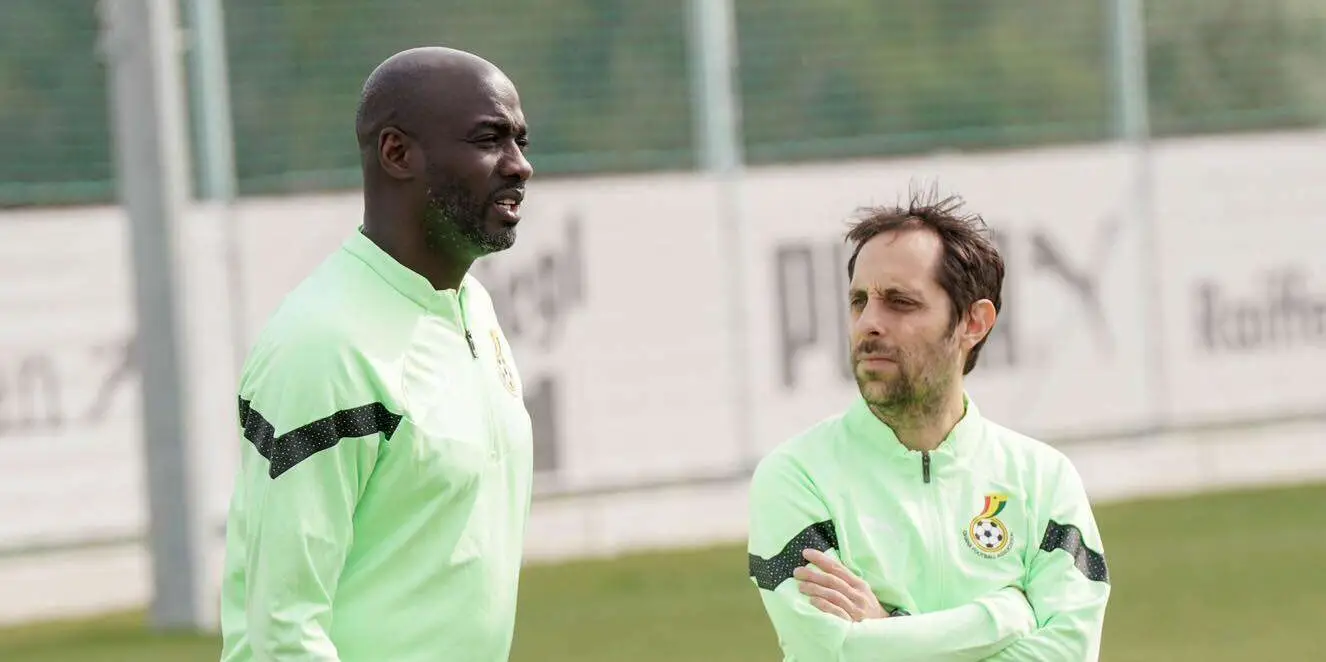
- Black Stars head coach Otto Addo dismissed immediately from his role, sending ripples through the national football landscape.
- Decision follows recent friendly defeats to Austria and Germany, raising serious concerns over team preparedness for the upcoming FIFA World Cup.
- Ghana Football Association (GFA) expresses gratitude for Addo's service amidst a pivotal period for the national team's World Cup ambitions.
- The Black Stars face a formidable challenge in Group L, where they are set to battle England, Panama, and Croatia in Qatar.
ACCRA, GHANA – In a dramatic turn of events that has sent shockwaves across Ghanaian football, Otto Addo has been relieved of his duties as head coach of the senior men’s national team, the Black Stars, with immediate effect. The decision, announced by the Ghana Football Association (GFA), comes at a most critical juncture, barely months before the highly anticipated FIFA World Cup tournament where Ghana is set to make its mark on the global stage once more.
The GFA’s announcement cited a series of disappointing performances, notably recent friendly defeats to European powerhouses Austria and Germany, as the catalyst for the drastic change. These results, far from inspiring confidence, had instead cast a dark cloud of concern over the team’s form, tactical cohesion, and overall preparedness for the immense challenge that awaits them in Group L of the World Cup.
The Pre-World Cup Jitters and Performance Scrutiny
The build-up to any FIFA World Cup is a period of intense scrutiny, with every friendly match, every training session, and every squad selection coming under the microscope of fans, pundits, and administrators alike. For the Black Stars, the friendlies against Austria and Germany were not merely exhibition games; they were crucial litmus tests designed to gauge the team’s readiness against top-tier opposition. Unfortunately, the outcomes suggested a team struggling for consistency and tactical identity.
The defeat to Austria was marked by a perceived lack of attacking impetus and defensive vulnerabilities, leaving many questioning the team’s ability to convert chances and maintain solidity at the back. This was compounded by the subsequent loss to Germany, a match where the Black Stars appeared overwhelmed at times, exposing cracks in their strategic approach and individual performances. While friendlies are often used for experimentation, the cumulative effect of these losses fueled a growing unease among the Ghanaian football fraternity, intensifying calls for decisive action ahead of the sport’s pinnacle event.
“The Association wishes to thank Otto Addo sincerely for his contribution to the team and wishes him the best of luck in his future endeavours,” the GFA statement read, acknowledging the customary courtesies that accompany such a significant departure. However, the succinctness of the statement belied the gravity of the decision, hinting at a move driven by urgent necessity rather than mere performance review.
Otto Addo’s Tumultuous Tenure: A Legacy of Highs and Lows
Otto Addo’s journey with the Black Stars has been a rollercoaster of emotions and outcomes. Initially stepping into an interim role, he captured the hearts of a nation by masterminding Ghana’s qualification for the 2022 FIFA World Cup, overcoming fierce rivals Nigeria in a tense playoff. This achievement was celebrated wildly, marking Ghana’s return to football’s grandest stage after missing the previous edition. Addo, leveraging his experience as a scout and assistant coach at Borussia Dortmund, was praised for his tactical acumen and ability to galvanize the squad under pressure.
His appointment to the permanent role subsequently signaled a belief in his long-term vision for the team. Yet, the challenges began almost immediately. Integrating new talent, particularly players with Ghanaian heritage from European clubs, proved a complex task. While some additions strengthened the squad, a consistent starting XI and a clear tactical philosophy often seemed elusive. Addo frequently juggled his national team commitments with his role at Dortmund, a dual responsibility that inevitably raised questions about his full dedication and availability to the Black Stars.
The 2022 World Cup saw the Black Stars exit at the group stage, a performance that, while containing moments of brilliance and resilience, ultimately fell short of the nation’s lofty expectations. The subsequent period, marked by a series of uneven performances in qualifiers and friendlies, suggested a team struggling to find its rhythm and identity under Addo’s leadership. The recent friendly defeats, therefore, were the final straw for an administration under immense pressure to deliver a credible showing at the upcoming tournament.
The Immediate Aftermath and World Cup Implications
Addo’s departure leaves a significant void at a crucial juncture. With the FIFA World Cup looming large, the Black Stars now face the daunting task of appointing a new head coach, integrating them into the existing setup, and rebuilding confidence – all within an extremely tight timeframe. This administrative and coaching upheaval threatens to disrupt vital World Cup preparations, potentially impacting player morale and tactical coherence.
Ghana’s challenge in Group L is already formidable. They are pitted against footballing giants England, a team boasting world-class talent and deep tournament experience. Alongside them are Croatia, perennial dark horses and recent World Cup finalists, known for their technical prowess and tactical discipline. Completing the group is Panama, an opponent often underestimated but capable of frustrating more illustrious teams with their organization and fighting spirit. Navigating such a group demands a stable, confident, and tactically astute unit, qualities that a coaching change could temporarily undermine.
The new coach will need to hit the ground running, quickly assessing the squad, implementing a clear tactical strategy, and fostering a strong team spirit. The psychological aspect will be paramount; restoring belief and focus within the squad will be as important as any tactical tweak. The GFA’s selection process will therefore be under intense scrutiny, with the nation holding its breath for a choice that can steer the Black Stars through this turbulent period.
Looking Ahead: The Search for a New Leader
The criteria for Otto Addo’s successor will undoubtedly be demanding. The GFA will be seeking a coach with proven international experience, a deep understanding of African football, and a track record of inspiring players to perform at the highest level. The ability to manage big personalities, adapt to different playing styles, and formulate a winning strategy for a diverse group of players will be non-negotiable.
The debate over whether to opt for a local or foreign coach will inevitably resurface, each option presenting its own set of advantages and disadvantages. A local coach might bring a deeper understanding of the culture and players, while a foreign coach could offer fresh perspectives and tactical innovations. Regardless of nationality, the chosen individual will inherit a team with immense potential but also significant pressure, tasked with transforming a fluctuating unit into a cohesive force capable of competing with the world’s elite.
The Black Stars’ journey to the World Cup now takes an unexpected detour, clouded by uncertainty but also renewed hope for a fresh start. The departure of Otto Addo marks the end of one chapter and the hurried beginning of another, as Ghanaian football braces itself for a rapid transition and the pivotal task of finding the right leader to guide its national heroes into the crucible of the FIFA World Cup.





0 Comments
Leave a Comment
No comments yet. Be the first to share your thoughts!