
Key Takeaways
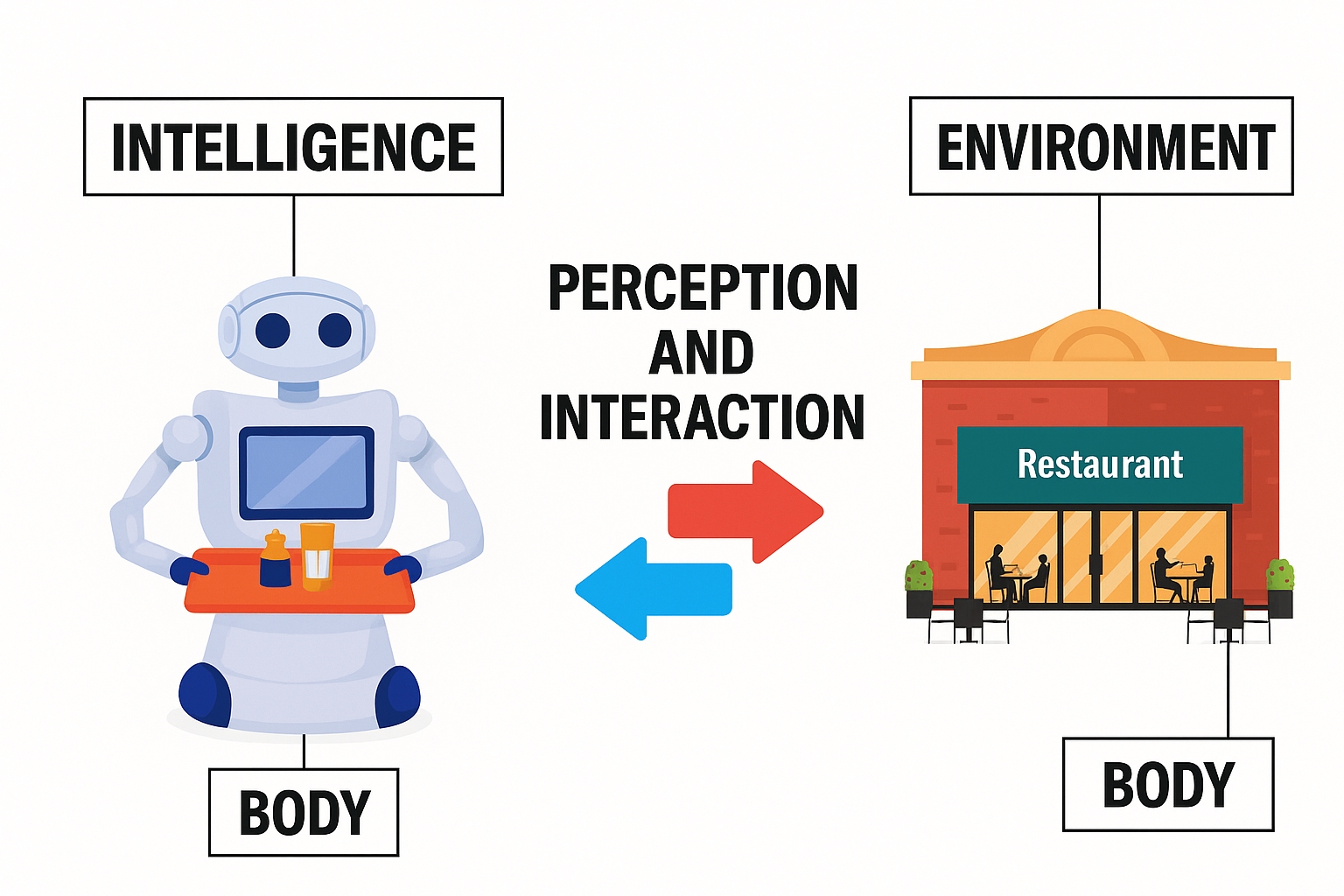
- Embodied intelligence enables AI to perceive, learn, move, and interact with its environment.
- It combines advances in robotics, sensing technologies, and machine learning to create adaptable and autonomous systems.
- The global robotics market is expected to reach $200 billion to $350 billion within the next decade.
The concept of embodied intelligence is gaining momentum in the tech world, pushing the boundaries of artificial intelligence (AI) and its applications. This innovative approach seeks to create machines that can interact with their environments like living organisms, blurring the lines between the physical and digital worlds.
Unlike traditional AI, which relies heavily on pre-programmed instructions, embodied intelligence emphasizes learning through real-world experience. By combining advances in robotics, sensing technologies, and machine learning, embodied AI systems can adapt to changing conditions, make decisions autonomously, and perform increasingly complex tasks.
A Brief History of Embodied Intelligence
The roots of embodied intelligence date back to 1950, when Alan Turing's Computing Machinery and Intelligence outlined two AI development paths: one abstract and the other emphasizing perceptual abilities and real-world action and learning. Since then, researchers have been working towards creating machines that can interact with their environments in a more human-like way.
Embodied intelligence is not a new concept, but recent advancements in technology have made it a more feasible and exciting field. Its core technology stack comprises three main parts: the body, which captures external and internal state information through sensors; the brain, which processes this data for perception, understanding, and planning; and the cerebellum, which converts decisions into concrete actions.
Challenges and Opportunities
Despite its potential, embodied intelligence faces significant technical challenges, including high implementation complexity in perception and motion control. Other challenges include the high cost and limited availability of real-world data, safety and security concerns, capital-intensive development, and unresolved issues surrounding toolchains, standardisation, ethics, and energy efficiency.
However, collaborative efforts among academia, industry, and government are helping to address these challenges. The outlook for embodied intelligence remains highly promising, paving the way for a more effective physical manifestation of AI to solve real-world problems.
Broader Implications
Embodied intelligence has the potential to help address critical issues in developing countries, including autonomous agricultural robots for precision farming, AI-powered healthcare assistants for underserved communities, intelligent waste collection and recycling systems, low-cost disaster-response and search-and-rescue robots, and adaptive educational robots that support learning in resource-constrained schools.
As embodied intelligence continues to evolve, it will likely have a significant impact on various industries, including healthcare, transportation, and education. Its potential to improve lives and address pressing global challenges makes it an exciting and promising field of research and development.
Looking Ahead
The future of embodied intelligence is bright, with significant potential to transform industries and improve lives. As researchers and developers continue to push the boundaries of this technology, we can expect to see more innovative applications and solutions to real-world problems.
Image Source: https://www.myjoyonline.com/wp-content/uploads/2026/06/Embodied-Intelligence.jpg





0 Comments
Leave a Comment
No comments yet. Be the first to share your thoughts!